Choosing the right business structure is one of the most important decisions a small business owner can make. While many entrepreneurs start as a sole proprietorship because it’s simple, transitioning to a Limited Liability Company (LLC) often provides stronger protection, credibility, and long-term growth opportunities.
In this guide, we’ll break down the main advantages of having an LLC over a sole proprietorship, and why forming an LLC is often a smart move for serious business owners.
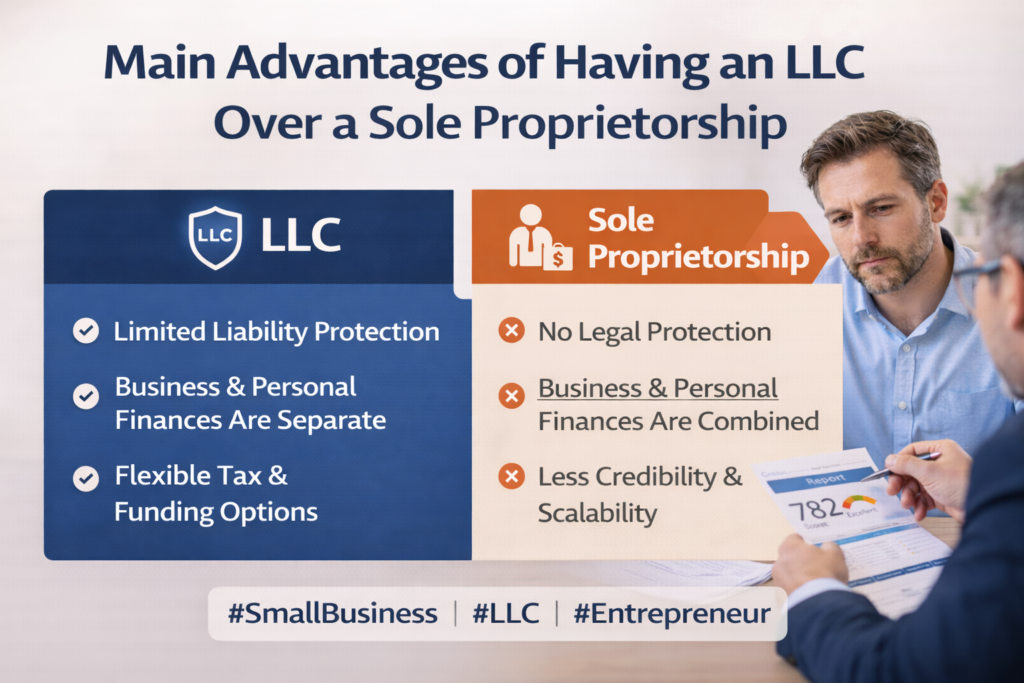
What Is a Sole Proprietorship?
A sole proprietorship is the simplest business structure:
- No formal registration required (in many states)
- Owner and business are legally the same
- Profits are reported on personal tax returns
While easy to start, sole proprietorships come with significant limitations and risks.
What Is an LLC?
An LLC (Limited Liability Company) is a legal business entity that:
- Separates the business from the owner personally
- Provides liability protection
- Offers flexible tax options
- Enhances credibility and scalability
LLCs are one of the most popular structures for small businesses in the U.S.
Main Advantages of an LLC Over a Sole Proprietorship
1. Personal Asset Protection (Limited Liability)
The biggest advantage of an LLC is liability protection.
With an LLC:
- Your personal assets (home, car, savings) are protected
- Business debts and lawsuits stay with the business
- Legal separation reduces personal financial risk
In a sole proprietorship, there is no legal separation—your personal assets are exposed.
2. Increased Business Credibility
Operating as an LLC immediately improves how your business is perceived.
Benefits include:
- Greater trust with customers and vendors
- Improved lender and bank confidence
- Professional brand image
Many clients and partners prefer working with registered business entities rather than individuals.
3. Easier Access to Business Funding
LLCs are far better positioned for funding approval.
An LLC allows you to:
- Open business bank accounts
- Establish business credit
- Qualify for loans, lines of credit, and funding programs
Most lenders prefer—or require—an LLC when offering business financing.
4. Separation of Business and Personal Finances
An LLC helps create clean financial separation by allowing:
- Dedicated business bank accounts
- Clear accounting records
- Simplified tax reporting
This separation reduces audit risk and improves financial clarity.
5. Flexible Tax Options
LLCs offer multiple tax treatment options:
- Default pass-through taxation
- Ability to elect S-Corp taxation (when eligible)
- Potential self-employment tax savings
Sole proprietorships have limited tax flexibility and fewer optimization strategies.
6. Stronger Business Credit Profile
LLCs can establish credit independently from the owner.
This allows:
- Reduced reliance on personal credit
- Higher funding limits over time
- Improved long-term financing options
Business credit is nearly impossible to build properly as a sole proprietor.
7. Easier Business Growth and Expansion
LLCs are designed for scalability.
They make it easier to:
- Add partners or investors
- Expand into new states
- Sell or transfer ownership
- Apply for government or corporate contracts
Sole proprietorships often hit growth ceilings quickly.
8. Professional Name Protection
Registering an LLC helps protect your business name within your state.
Benefits include:
- Reduced risk of name duplication
- Brand protection
- Professional identity for marketing and contracts
Sole proprietors typically have limited name protection.
9. Simplified Business Continuity
An LLC can continue operating even if ownership changes.
This is ideal for:
- Succession planning
- Long-term brand building
- Creating a sellable business asset
A sole proprietorship usually ends if the owner stops operating.
10. Better Long-Term Wealth Building
LLCs support:
- Asset accumulation
- Business valuation
- Exit strategies
- Legacy planning
A sole proprietorship is tied entirely to the owner, limiting long-term wealth potential.
Are There Any Downsides to an LLC?
While LLCs offer major advantages, they do require:
- Filing formation documents
- Annual state fees
- Basic compliance and recordkeeping
However, these costs are usually minimal compared to the protection and benefits gained.
LLC vs Sole Proprietorship: Which Is Right for You?
A sole proprietorship may work if:
- You’re testing an idea
- Revenue is very limited
- Risk exposure is minimal
An LLC is ideal if:
- You want asset protection
- You plan to grow or seek funding
- You want long-term stability and credibility
For most serious entrepreneurs, an LLC is the clear winner.
Final Thoughts
The advantages of having an LLC over a sole proprietorship go far beyond paperwork. An LLC protects your personal assets, improves credibility, unlocks funding opportunities, and sets your business up for sustainable growth.
If your goal is to build a real business—not just a side hustle—forming an LLC is often the smartest next step.
Need Personal Or Business Funding? Prestige Business Financial Services LLC offer over 30 Personal and Business Funding options to include good and bad credit options. Get Personal Loans up to $100K or 0% Business Lines of Credit Up To $250K. We provide Business Credit building (Paydex80) services and Personal Credit building servcies Also Enhanced Credit Repair ($249 Per Month) and Passive income programs (Can Make 5-10% Per Month; Trade $100K of Someone Esles Money). Our 2nd Passive Income Program could make 1-2% Per Day Compounding ($500 to Start, In 2 years could be $6 Million).
Book A Free Consult And We Can Help – https://prestigebusinessfinancialservices.com
Email – anthony@prestigebfs.com
Phone- 1-800-622-0453