Many people proudly say, “I have good credit.”
Yet when they apply for funding, they’re shocked to receive a denial or a much smaller approval than expected.
👉 Here’s the truth: good credit is not the same as fundable credit.
In 2025, lenders don’t just approve based on scores — they approve based on structure, behavior, and risk signals. This misunderstanding is one of the biggest reasons small business owners miss out on $25K–$250K+ in funding.
This article breaks down the real difference between good credit and fundable credit — and how to position yourself so lenders say yes.
What Is “Good Credit”?
Good credit is usually defined by a score.
Typically:
- 680–720+ FICO score
- On-time payment history
- No recent major derogatory events
Good credit looks nice on paper — but it doesn’t tell lenders how risky you are today.
Why Good Credit Alone Doesn’t Guarantee Funding
In 2025, lenders use advanced underwriting models that analyze more than just your score.
They evaluate:
- Credit utilization trends
- Recent inquiries
- Account behavior
- Debt-to-income ratios
- Banking activity
- Timing of applications
You can have a 720 score and still look high risk.
What Is Fundable Credit?
Fundable credit is credit that is structured, optimized, and positioned for approvals.
It answers the lender’s real question:
“Can we safely lend this person a large amount of money right now?”
Fundable credit focuses on how your credit behaves, not just how it scores.
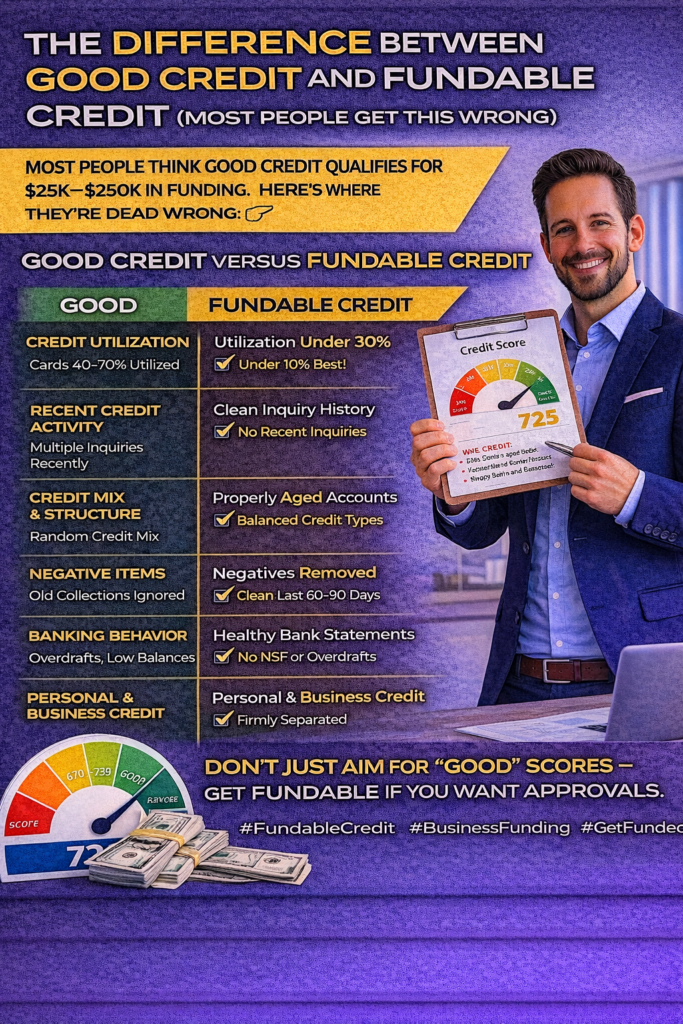
🔍 Key Differences Between Good Credit and Fundable Credit
1️⃣ Credit Utilization
Good credit:
- Cards may be 40–70% utilized
Fundable credit:
- Utilization under 30%
- Under 10% for top-tier approvals
📌 High balances are one of the fastest ways to lose funding power.
2️⃣ Recent Credit Activity
Good credit:
- Multiple recent applications
- Several hard inquiries
Fundable credit:
- Clean inquiry history
- Strategic, well-timed applications
Lenders prefer patience and planning over urgency.
3️⃣ Credit Mix & Structure
Good credit:
- Random mix of cards and loans
Fundable credit:
- Properly aged accounts
- Balanced revolving and installment credit
- Limits that support low utilization
Structure matters as much as score.
4️⃣ Negative Items
Good credit:
- Old collections or charge-offs ignored
Fundable credit:
- High-impact negatives addressed or removed
- Clean recent history (last 60–90 days)
Recent behavior outweighs old mistakes.
5️⃣ Banking Behavior
Good credit:
- Bank overdrafts
- Low average balances
Fundable credit:
- Clean bank statements
- Consistent deposits
- No NSF or overdraft fees
Credit and banking work together.
6️⃣ Personal vs Business Credit
Good credit:
- Personal credit only
Fundable credit:
- Personal credit optimized
- Business credit established
- Separation of finances
This is how entrepreneurs unlock six-figure funding.
Why Lenders Care About Fundable Credit
Lenders are not emotional — they are statistical.
Fundable credit signals:
✔ Stability
✔ Predictability
✔ Lower default risk
✔ Strong repayment likelihood
Good credit without structure still looks risky.
How to Turn Good Credit Into Fundable Credit
✅ Optimize utilization before applying
✅ Pause applications for 60–90 days
✅ Clean up recent negatives
✅ Improve bank statement behavior
✅ Build and report business credit
✅ Apply with a strategy — not desperation
Most people don’t need better credit — they need better positioning.
What a Fundable Credit Profile Looks Like
Borrowers who get approved consistently show:
- Low utilization
- Minimal recent inquiries
- Clean recent payment history
- Strong banking activity
- Business credit in place
- Strategic application timing
This profile unlocks larger limits, better terms, and repeatable funding.
Final Thoughts
Good credit helps you sleep at night.
Fundable credit helps you get approved.
If lenders keep saying no, the problem usually isn’t your score — it’s your credit structure.
Once you shift from “good” to fundable, funding becomes predictable instead of frustrating.
Need Personal Or Business Funding? Prestige Business Financial Services LLC offer over 30 Personal and Business Funding options to include good and bad credit options. Get Personal Loans up to $100K or 0% Business Lines of Credit Up To $250K. Also Enhanced Credit Repair ($249 Per Month) and Passive income programs (Can Make 5-10% Per Month; Trade $100K of Someone Esles Money). Our 2nd Passive Income Program could make 1-2% Per Day Compounding ($500 to Start, In 2 years could be $6 Million).
Book A Free Consult And We Can Help – https://prestigebusinessfinancialservices.com
Email – anthony@prestigebfs.com
Phone- 1-800-622-0453
🚀 Call to Action
If you want to:
- Turn your credit into a fundable profile
- Qualify for personal or business funding
- Unlock $25K–$250K+ in approvals
- Stop guessing and start getting approved
Prestige Business Financial Services can help.
👉 Visit: www.prestigebusinessfinancialservices.com
👉 Or message “Fundable Credit” for a free credit and funding evaluation